Week 8 Legislative Session Recap 2026
March 2 - 6, 2026
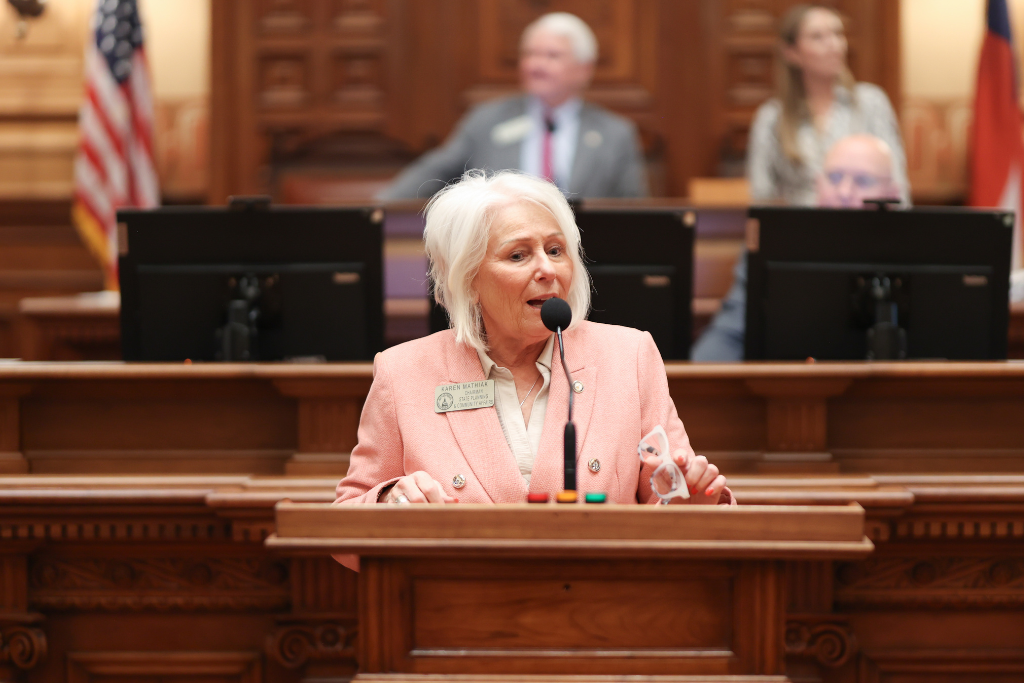
The Georgia House of Representatives returned to the State Capitol on Monday, March 2, for one of the busiest stretches of the 2026 legislative session. The week built toward Legislative Day 28, Crossover Day, the critical deadline for legislation to pass out of its originating chamber in order to remain eligible for final passage before the General Assembly adjourns Sine Die. As we approached Crossover Day, House members worked through two committee workdays and two legislative days, often late into the evening. During the week, members also joined Governor Brian Kemp as he signed House Bill 973, the Amended Fiscal Year 2026 budget, into law. By the end of the eighth week of session, the House had passed 97 bills and resolutions and sent many measures to the Senate.
During week eight, the House passed the following legislation:
- House Bill 1000 – One-Time Tax Refund for Georgians
- Passed unanimously to provide a one-time income tax refund to qualified taxpayers.
- Eligible individuals must have filed Georgia income tax returns for both the 2024 and 2025 tax years.
- Refunds would be issued automatically by the Georgia Department of Revenue after filing a 2025 return.
- Maximum refund amounts based on filing status:
- $250 for single filers or married filing separately
- $375 for heads of household
- $500 for married couples filing jointly
- The refund would equal the lesser of the taxpayer’s 2024 Georgia income tax liability or the applicable cap.
- House Bill 1402 – Student Vision and Hearing Screenings
- Requires annual vision and hearing screenings for public-school students from pre-K through third grade.
- Screenings would be conducted at school by trained personnel or a qualified third party.
- The Georgia Department of Public Health would oversee training, screening protocols and statewide data collection.
- Annual reports comparing screening results with student academic performance would be submitted to the General Assembly.
- Provides one-time grants of up to $15,000 per school district, subject to appropriations, to purchase screening equipment.
- Parents would receive advance notification and may opt their child out of screenings.
- House Bill 1413 – DREAMS Scholarship Program
- Establishes the Dedicating Resources to Educationally Advance More Students (DREAMS) Scholarship.
- Administered by the Georgia Student Finance Authority.
- Provides up to $3,000 annually for undergraduate students with demonstrated financial need.
- Eligible students must attend institutions within the University System of Georgia or the Technical College System of Georgia.
- Scholarships may be awarded for up to eight semesters or 12 quarters.
- Creates a dedicated endowment fund supported by public and private contributions.
- Includes a medical scholarship program encouraging graduates to practice medicine in Georgia for at least four years following residency.
- House Bill 1187 – Trey’s Law
- Unanimously passed to prohibit nondisclosure agreements that silence victims of childhood sexual abuse.
- Invalidates contracts preventing victims from speaking about abuse or related facts.
- Allows settlement amounts and unrelated contractual terms to remain confidential.
- Named in memory of Trey Carlock, whose experience highlighted the harm caused by restrictive NDAs.
- House Bill 1290 – Sexual Abuse Protections for Vulnerable Adults
- Strengthens protections for older adults and individuals with disabilities.
- Redefines sexual abuse to focus on lack of consent rather than requiring proof of coercion.
- Establishes a new “dangerous sexual offenses” category within Georgia’s sexual offender registry.
- Adds willful sexual abuse of a disabled adult, older adult or long-term care resident to the registry.
- House Bill 1283 – Family Justice Center Act
- Authorizes the creation of Family Justice Centers to provide coordinated services for victims of family violence, sexual assault, child abuse, elder abuse and human trafficking.
- Centers may be operated by local governments, district attorneys or nonprofit organizations.
- Governing boards would include representatives from law enforcement, prosecution, social services and victim advocacy groups.
- Grant funding would be administered by the Georgia Criminal Justice Coordinating Council.
- Includes strict confidentiality protections for victims.
- Designed to allow victims to access multiple services in one location rather than visiting several agencies.
- House Bill 1230 – Drone Restrictions Over Correctional Facilities
- Prohibits the operation of unmanned aircraft systems over prisons and jails.
- Makes it unlawful to allow such drone activity from one’s property.
- Classifies drones used in violations as contraband subject to seizure or destruction.
- Authorizes law enforcement to take reasonable mitigation measures when unauthorized drones are detected.
- House Bill 1138 – Increasing Access to Contraceptives Act
- Allows pharmacists to prescribe and dispense certain hormonal contraceptives, including pills and patches.
- Authorizes pharmacists to administer injectable contraceptives.
- Requires completion of accredited training before pharmacists can provide these services.
- Requires insurers, Medicaid and other state programs to cover extended contraceptive supplies.
- Expands access to birth control in communities with limited OB-GYN availability.
- House Bill 1118 – Maternal Birth Leave Expansion
- Provides eligible state employees with 120 hours of paid maternal birth leave within the first three weeks after childbirth.
- Requires at least six months of employment prior to leave eligibility.
- Hourly employees must have worked a minimum of 700 hours in the previous six months.
- Funded through existing leave budgets with no additional cost to the state.
- House Bill 1045 – You Are Not Alone Awareness Act
- Requires student ID badges for grades six through 12 to include a message promoting the 988 crisis hotline.
- The message encourages students experiencing emotional distress, suicidal thoughts or substance abuse challenges to call or text 988.
- Applies to badges issued on or after July 1, 2026.
- Helps ensure students across Georgia have consistent access to crisis resources.
- House Bill 1114 – Financial Literacy Education Standards
- Requires the Georgia State Board of Education to develop age-appropriate financial literacy standards for K–12 students.
- High school students would complete a half-credit course in financial literacy beginning in the 2026–2027 school year.
- Curriculum topics include budgeting, banking, credit, investing, fraud prevention and gambling risks.
- Financial literacy instruction would also be integrated into middle and elementary school curricula by the 2027–2028 school year.
- House Bill 1112 – Cash Rounding for Pennies
- Establishes a standardized rounding system for cash transactions to the nearest five cents.
- Totals ending in one, two, six or seven cents would round down; totals ending in three, four, eight or nine cents would round up.
- Electronic payments would not be affected.
- Consumers could still pay the exact amount using pennies.
- Merchants using the rounding system would not violate state or local regulations.
- House Bill 1122 – Peripheral Artery Disease Screening Coverage
- Expands insurance coverage for screenings for Peripheral Artery Disease for at-risk individuals ages 50 to 64.
- Coverage would apply to health policies issued or renewed beginning January 1, 2027.
- The screening is a simple, noninvasive test similar to a blood pressure check performed at the ankle.
- Aims to improve early detection and reduce amputation rates associated with untreated vascular disease.
- House Resolution 1000 – Timber Tax Constitutional Amendment Proposal
- Would allow standing timber to be assessed at zero percent ad valorem tax when under a qualifying-use covenant.
- If the covenant is broken within 10 years after harvest or sale, the tax savings would be recaptured.
- Requires the state to reimburse counties, municipalities and school districts for any lost revenue.
- If approved by the Senate, the proposal would appear on a statewide ballot referendum for voters to consider.
- House Bill 668 – Service Dog Protection Act
- Establishes criminal penalties for interfering with or harming a service dog.
- Provides restitution for veterinary care, retraining or replacement of injured service dogs.
- Extends legal protections to trainers and handlers.
- Expands eligibility for service dog assistance to individuals with physical or mental impairments.
- Creates penalties for falsely claiming the need for a service dog.
Additional measures passed include:
- House Bill 158 – Establishes uniform business registration forms and a statewide filing registry.
- House Bill 275 – Improves clarity and transparency in property tax assessment notices.
- House Bill 295 – Allows property owners to seek compensation for losses caused by local government failures.
- House Bill 334 – Requires yearly reviews of Medicaid coverage for sickle cell disease treatments.
- House Bill 376 – Revises tax credits and thresholds for rehabilitating certified historic structures.
- House Bill 382 – Permits certain FDA-approved psychedelic medications and updates pharmacy supervision rules.
- House Bill 421 – Expands criminal penalties for traveling to commit child molestation offenses.
- House Bill 438 – Lowers retirement eligibility age for sworn officers in the Department of Public Safety.
- House Bill 547 – Allows consolidation of conservation property covenants and recognizes carbon capture uses.
- House Bill 641 – Requires protections for electric customers with life-threatening medical conditions.
- House Bill 664 – Standardizes voting requirements for homeowners association covenant changes.
- House Bill 717 – Directs development of rules for psychedelic-assisted medical treatment clinics.
- House Bill 874 – Protects taxpayer privacy in publicly accessible property tax records.
- House Bill 880 – Expands tax exemptions and deductions for families and retirees.
- House Bill 892 – Prohibits massage therapy businesses from operating late-night hours.
- House Bill 947 – Enhances oversight, eligibility verification and reporting for SNAP benefits.
- House Bill 951 – Requires insurance coverage for medically necessary prosthetic and orthotic devices.
- House Bill 961 – Limits patient costs for emergency ambulance services and surprise billing.
- House Bill 962 – Updates tax benefits and limits for higher education savings accounts.
- House Bill 963 – Requires certification that campaign funds are not tied to foreign nationals.
- House Bill 967 – Creates grants for bullet-resistant equipment in law enforcement vehicles.
- House Bill 979 – Establishes procedures for transferring federal jurisdiction of land back to the state.
- House Bill 990 – Provides veterinary care assistance for retired law enforcement dogs.
- House Bill 1076 – Creates a felony offense for obstructing law enforcement with a vehicle.
- House Bill 1077 – Extends the sales tax exemption for fine arts events.
- House Bill 1087 – Eliminates certain fees for home accessibility upgrades for disabled veterans.
- House Bill 1116 – Introduces major property tax reform and a homestead sales tax option.
- House Bill 1128 – Expands notification requirements for indemnification claims involving public safety officers.
- House Bill 1129 – Restricts tax incentives and financing rules for enterprise zones.
- House Bill 1132 – Grants sales tax exemptions for charitable affordable housing construction.
- House Bill 1133 – Allows solar energy projects on closed landfill sites.
- House Bill 1134 – Updates legal procedures for repossession of motor vehicles.
- House Bill 1142 – Creates a public registry for repeat domestic violence offenders.
- House Bill 1148 – Extends and increases tax credits for conservation land donations.
- House Bill 1159 – Exempts certain federal agricultural assistance payments from state income tax.
- House Bill 1166 – Limits zoning restrictions on very small residential dwellings.
- House Bill 1178 – Establishes a House committee to oversee budget and fiscal policy.
- House Bill 1191 – Expands special license plates recognizing military service awards.
- House Bill 1192 – Requires expanded reporting on health and human services programs.
- House Bill 1195 – Broadens the use of veterinary telemedicine and remote triage.
- House Bill 1196 – Creates criminal penalties for trespassing into wild animal enclosures.
- House Bill 1201 – Updates statewide requirements for smoke alarm safety standards.
- House Bill 1208 – Modernizes court reporting methods beyond traditional stenography.
- House Bill 1209 – Provides limited sales tax incentives for certain convention-area development.
- House Bill 1211 – Updates medical guideline references for colorectal cancer screening coverage.
- House Bill 1220 – Expands eligibility for private school scholarship programs.
- House Bill 1234 – Allows life insurance benefits to be assigned directly to funeral services.
- House Bill 1238 – Seeks federal approval to reimburse certain youth behavioral health caregivers through Medicaid.
- House Bill 1247 – Ends judicial deference to state agency interpretations of law.
- House Bill 1254 – Consolidates several professional licensing functions under the Secretary of State.
- House Bill 1261 – Provides a property tax exemption for certain electric utility inventory.
- House Bill 1266 – Limits personal watercraft activity in parts of the Ogeechee River.
- House Bill 1268 – Annual technical update to revise and correct Georgia’s statutory code.
- House Bill 1272 – Establishes state regulation and licensing for payment stablecoin issuers.
- House Bill 1275 – Allows certain ethically sourced stem cell therapies for treatment.
- House Bill 1284 – Allows terminally ill students to receive high school diplomas.
- House Bill 1285 – Allows counties to collect both enhanced and standard local sales taxes.
- House Bill 1293 – Updates eligibility and funding formulas for the Dual Achievement workforce program.
- House Bill 1295 – Joins a multistate licensing compact for physician assistants.
- House Bill 1296 – Creates a pilot program studying innovative treatments for veterans and first responders.
- House Bill 1302 – Restructures Georgia’s workforce and education coordination systems.
- House Bill 1303 – Criminalizes possession of drugs in the presence of young children.
- House Bill 1310 – Designates cotton as Georgia’s official state fabric.
- House Bill 1328 – Expands military scholarship eligibility at the University of North Georgia.
- House Bill 1345 – Authorizes approval of workforce training programs tied to federal Pell Grants.
- House Bill 1365 – Adds a new superior court judge to the Atlanta Judicial Circuit.
- House Bill 1368 – Updates governance and leadership rules for community service boards.
- House Bill 1374 – Protects healthcare providers’ ability to choose payment methods.
- House Bill 1379 – Requires disclosure of foreign funding received by public colleges.
- House Bill 1391 – Creates a specialty license plate honoring public safety officers.
- House Bill 1393 – Allows rural hospitals to coordinate services and shared resources.
- House Bill 1396 – Requires certain homeless service providers to participate in statewide data systems.
- House Bill 1408 – Expands authority for veterinarians and technicians to administer rabies vaccines.
- House Bill 1409 – Expands mandated reporters and updates child abuse reporting procedures.
- House Bill 1415 – Requires inventory and oversight of property owned by the Stone Mountain Memorial Association.
- House Bill 1432 – Strengthens legislative oversight of the Georgia Public Defender Council.
- House Bill 1434 – Requires zoning safeguards for areas affected by airport flight paths.
- House Bill 1465 – Eliminates vehicle registration renewal decals starting in 2027.
- House Bill 1470 – Allows damages for defendants in unsuccessful ADA website lawsuits.
- House Resolution 1243 – Proposes a constitutional amendment funding Next Generation 9-1-1 upgrades.
- House Resolution 1300 – Annual legislative package dedicating state roadways.
- House Resolution 1416 – Creates a study committee on sustaining family farms across generations.
The House reconvened at the Capitol on Monday, March 9, for Legislative Day 29. With Crossover Day now behind us, House members will begin considering Senate-passed legislation while the Senate reviews measures approved by the House. As the 2026 legislative session moves toward adjournment on April 2, I encourage you to reach out with any questions or concerns about legislation under consideration. Your input is invaluable, and I welcome the opportunity to speak with you. Please feel free to contact my Capitol office at karen.mathiak@house.ga.gov or (404) 656-0213. As always, thank you for the privilege of serving as your state representative.
Updates From Karen Mathiak